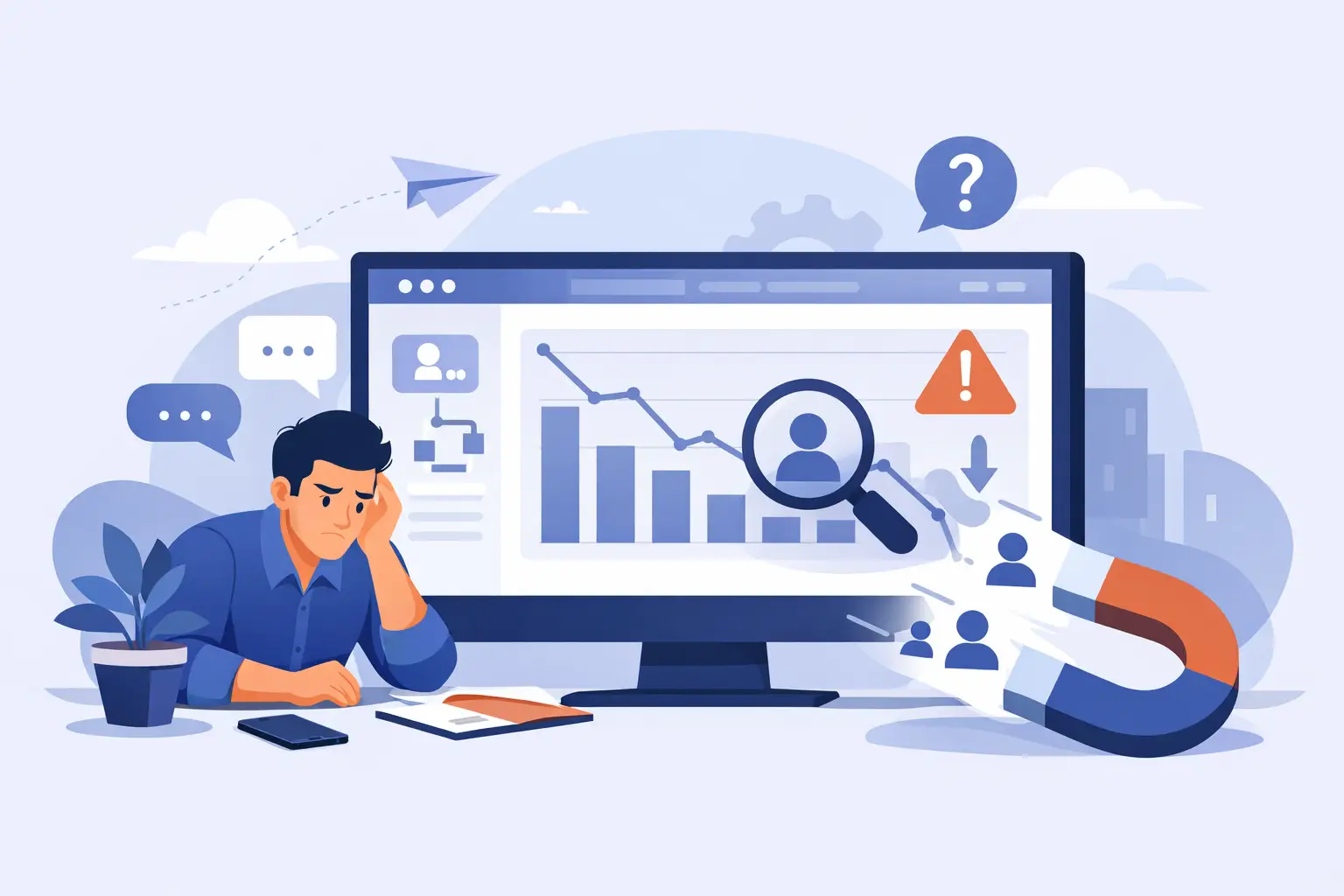
If you're asking why my website is not getting leads, the problem usually is not traffic alone. Most local business sites lose leads because they confuse visitors, slow them down, or fail to ask for action at the right moment. A website can look polished and still underperform where it counts - phone calls, quote requests, bookings, and form submissions.
That gap frustrates a lot of business owners because they did the part they thought mattered. They paid for a site, added service pages, maybe even ran ads or worked on SEO. But if the site behaves like an online brochure instead of a customer acquisition system, traffic does not turn into revenue.
Why my website is not getting leads: the real issue
Most websites are built to exist, not to convert. They explain the business, show a few photos, add a contact page, and stop there. That might have worked years ago. It does not work well now, especially in competitive local markets where buyers compare three or four options in minutes.
People do not visit your site to admire the layout. They come with a job to do. They want to know if you serve their area, solve their problem, charge reasonably, and make it easy to take the next step. If your site does not answer those questions quickly, they bounce and call the next business.
This is where many agencies miss the mark. They obsess over visual style and ignore buying behavior. For a local HVAC company, law firm, dental office, or restaurant, the website should be engineered around action. No agency theater. Just a clear path from visit to lead.
Your message is too vague
A common reason websites fail is weak positioning above the fold. When someone lands on your homepage, they should immediately understand what you do, who you help, and what they should do next. If your headline says something broad like "quality solutions for your needs," that is not messaging. That is wallpaper.
Strong messaging is specific. A roofer should say they handle roof repair and replacement in the exact market they serve. A med spa should clearly present the treatments people actually book. A law firm should say what case types they take and what consultation step comes next.
Generic copy kills urgency. It also makes you look interchangeable. If your site sounds like every competitor, visitors compare on price or leave entirely.
Your call to action is weak or buried
A surprising number of business websites never clearly ask for the lead. The phone number is tiny, the contact form is hidden in the footer, or the main button says something soft like "learn more." That is not enough.
If you want booked calls, estimate requests, table reservations, or consultations, the site needs to present those actions early and often. The primary call to action should be obvious on mobile and desktop. It should match how people naturally buy in your category.
That last part matters. A restaurant may need reservations front and center. A personal injury firm may need a free case review. A plumber may need a click-to-call option for urgent jobs and a quote form for non-emergency work. Good conversion strategy is industry-specific.
Your mobile experience is costing you leads
For most local businesses, the majority of visitors come from a phone. Yet a lot of sites are still designed desktop-first and only technically work on mobile. That is not the same as being easy to use.
If your buttons are hard to tap, your text is cramped, your forms are annoying, or your pages load slowly on cellular data, your conversion rate drops fast. Mobile users are impatient because they are often in motion, distracted, or trying to make a quick decision.
This is one of the clearest answers to why my website is not getting leads. If the mobile experience creates friction, intent disappears. A homeowner looking for emergency HVAC service at 7 p.m. is not going to pinch and zoom through your homepage. They will leave.
You are asking for too much too early
Some websites treat every visitor like they are already sold. They throw a long contact form in front of them asking for ten fields, project details, budget, timeline, and preferred appointment windows. That is too much friction for a first step.
Lead capture should feel easy. Name, phone, email, and one short message field is often enough. In some cases, even less is better if the goal is speed. If your sales process requires more detail, collect it after the initial conversion, not before.
There is a trade-off here. More form fields can improve lead quality, but they often reduce total lead volume. For many local service businesses, simpler forms produce better results because speed wins.
Your site lacks proof
Visitors do not just need information. They need confidence. If your website makes claims without backing them up, people hesitate. Reviews, before-and-after examples, case-specific outcomes, photos of real work, credentials, service area trust signals, and clear process explanations all reduce doubt.
Proof has to match the type of business. A dentist might need testimonials, insurance info, and office photos. A lawn care company may benefit from service plan clarity and local job photos. A law firm needs authority and trust. An auto repair shop needs legitimacy, transparency, and convenience.
Social proof should not be tucked away on a single testimonials page that nobody visits. It should support key decision moments throughout the site.
Your traffic is unqualified
Sometimes the site is not the only problem. If you are attracting the wrong visitors, leads will stay low no matter how clean the design is. This happens when SEO targets broad vanity keywords, ads point to irrelevant pages, or the site does not clearly define service area and offer.
A local business needs qualified traffic, not random traffic. If you are a Phoenix-based chiropractor, traffic from outside Arizona does not help. If you only offer premium kitchen remodeling, bargain-hunting visitors looking for handyman pricing are not your buyers.
This is why traffic and conversion strategy have to work together. More clicks are not automatically better. Better-fit clicks are.
Your pages do not match search intent
When someone searches "emergency plumber near me," they want fast help. When they search "Invisalign dentist cost," they want pricing context and trust. When they search "best divorce lawyer in Dallas," they want credibility, clarity, and a next step.
If your landing page does not match the reason they searched, you lose them. Many websites send all traffic to the homepage and expect it to do everything. That is lazy strategy. Service pages should be built around actual intent, with copy, proof, and calls to action that fit the search.
This is one reason local websites that rank still underperform. They got the click but failed the handoff.
Your load speed and technical setup are dragging performance
A slow site does more damage than most owners realize. It hurts user trust, conversion rates, and often visibility as well. Heavy images, bloated themes, messy plugins, weak hosting, and poor code can all contribute.
Not every speed issue needs a total rebuild, but some do. If your current setup is patched together and every update breaks something, you are paying hidden costs in lost leads and wasted time. Fast sites convert better because they respect user intent.
Technical issues also show up in quieter ways. Broken forms, missing thank-you pages, bad call tracking setup, and unclear analytics can make it look like the site is fine when leads are actually leaking.
What to fix first if your website is not getting leads
Start with the homepage hero section. Make the offer specific, the service area obvious, and the primary call to action impossible to miss. Then check your mobile experience as if you were a customer in a hurry. If the path to call, book, or request a quote feels clunky, fix that next.
After that, tighten your forms, strengthen your proof, and make sure each core service has its own conversion-focused page. Review where traffic comes from and whether those visitors are actually the right fit. Then test what happens after conversion. If leads come in but do not close, the issue may be response time or follow-up rather than the website alone.
That is the part many businesses overlook. A site should not just collect leads. It should attract the right ones and hand them off cleanly to your sales process.
For local businesses, the standard should be simple. Your website should win customers, not just visitors. If it is not doing that, the answer is usually not more decoration. It is a clearer offer, less friction, better proof, and a faster path to action.

